

November 16, 2025
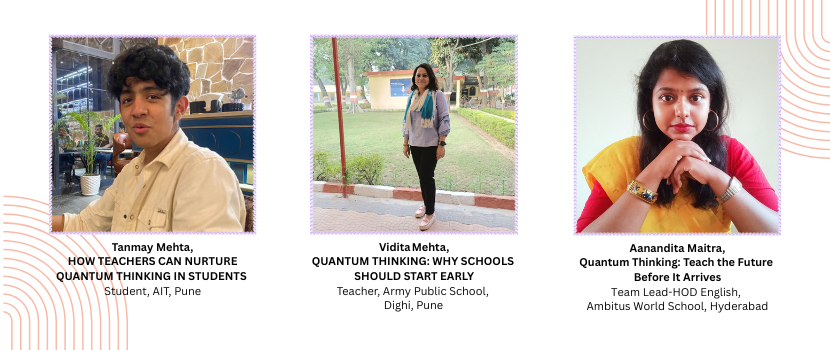
HOW TEACHERS CAN NURTURE QUANTUM THINKING IN STUDENTS
By Vidita Mehta, Teacher, Army Public School, Dighi, Pune
Teachers can help students think quantum by encouraging exploration over certainty, questions over conclusions, and connections over silos. When students learn to embrace ambiguity, see multiple angles, and imagine new possibilities, they become more creative, resilient, and future-ready—exactly what quantum thinking aims to achieve.
Quantum thinking encourages students to move beyond rigid, binary choices and instead explore multiple possibilities, connections, and perspectives at the same time. For teachers, the goal is not to teach quantum physics but to cultivate a mindset of openness, creativity, and non-linear thinking. Here’s how educators can build this in everyday classrooms:
1. Ask Open-Ended, Multi-Perspective Questions
Shift from “What is the right answer?” to “What are all the ways this could work?”
Encourage students to explore several solutions, viewpoints, or interpretations.
Use prompts like “What else could be true?”, “How might someone else see this?”
2. Teach Students to Hold Two Ideas at Once
Introduce the concept of “dual possibilities.”
Ask them to compare two opposing ideas without choosing immediately.
Encourage statements like, “Both could be true depending on….”
3. Use Mind Maps and Web Thinking
Replace linear notes with interconnected maps.
Show students how ideas relate, overlap, and influence each other.
This mirrors the quantum idea of entanglement.
4. Encourage ‘What If?’ Thinking
Build imaginative flexibility.
“What if we reversed the roles?”
“What if the opposite happened?”
“What if there was no limitation?”
This expands creative thinking beyond the obvious.
5. Normalize Uncertainty and Delay Judgement
Teach students that not knowing is part of learning.
Have them pause before concluding.
Celebrate thoughtful risk-taking instead of only accuracy.
6. Make Collaboration Essential
Let students think with others.
Group tasks where ideas build on one another.
Highlight how insights travel and transform through peers—like “entangled minds.”
7. Model Quantum Thinking as a Teacher
Show your own process out loud.
Share multiple interpretations when presenting a topic.
Demonstrate how you explore possibilities instead of closing discussions quickly.
8. Connect Learning Across Subjects
Break the artificial silos of science, art, literature, and technology.
Show how concepts intersect and create new ideas.
Encourage students to design cross-disciplinary projects.
9. Encourage Small Experiments
Let students test possibilities instead of just planning.
Quick prototypes, trials, alternate solutions, and reflections build adaptability.
10. Build Intuition Alongside Logic
Ask students to reflect on both:
“What does your analysis say?”
“What does your instinct suggest?” This teaches them to use full-brain thinking.
QUANTUM THINKING: WHY SCHOOLS SHOULD START EARLY
By Tanmay Mehta, Student, AIT, Pune
Quantum thinking equips students with the mindset needed for a world where the ability to navigate uncertainty, innovate, and connect ideas matters more than memorizing facts. Introducing it early gives schools a powerful way to prepare children for the future—where adaptability, creativity, and holistic thinking are the new essentials.
Quantum thinking is a modern approach that trains the mind to see multiple possibilities, hold different perspectives at once, and understand how ideas, people, and actions are interconnected. In a world where knowledge becomes outdated quickly, the real skill students need is not more information, but the ability to adapt, unlearn, and relearn.
Traditional schooling often relies on linear, step-by-step thinking. Quantum thinking teaches children to move beyond “right vs. wrong” or “true vs. false” and instead explore a spectrum of possibilities—much like the principles of superposition and entanglement in quantum science. This builds comfort with uncertainty, creativity, and complex problem-solving.
Why Schools Should Teach It Early
Builds adaptable learners: Students learn to shift perspectives quickly and understand that problems can have multiple solutions.
Strengthens creativity and innovation: By holding two opposing ideas at once, children become better at imagining new possibilities instead of relying only on fixed answers.
Reduces tunnel vision: Students learn to look at issues from all sides, avoiding narrow thinking and becoming more empathetic and collaborative.
Prepares for a VUCA world: In volatile and fast-changing environments, those who thrive are not the ones who know the most, but the ones who can think differently.
Encourages holistic understanding: Students begin to see how decisions, actions, and systems are connected—an essential skill for future leaders, entrepreneurs, scientists, and creators.
In Practice for Schools
Quantum thinking helps students ask better questions:
Why is this happening? (root-cause thinking)
What if…? (expansive, creative thinking)
If not this, then what? (adaptive problem-solving)
Teaching this early develops flexible, confident, and future-ready learners who can embrace complexity rather than fear it. For educators, it shifts the focus from merely improving outcomes to re-imagining the systems and assumptions behind them.
REWRITING A TEACHER’S RESOURCES IN THE AI-DRIVEN ECONOMY
By Aanandita Maitra — Team Lead-HOD English, Ambitus World School, Hyderabad
Abstract
In a world defined by uncertainty and rapid change, traditional linear thinking no longer equips
students for the future. This article introduces quantum thinking — a mindset that applies the logic
of quantum theory to education, encouraging flexibility, systems awareness, and reflective learning.
Drawing on recent researches, it argues for introducing this approach early in schools. Practical
classroom ideas and real experiences illustrate how embracing ambiguity helps students think
critically, adapt ethically, and navigate complexity with confidence.
Main Article
Introduction
Imagine walking into a classroom where the compass on the wall sometimes points north, sometimes
spins freely — not broken, but reacting to invisible forces. That spinning compass tells us something
profound about our world today: technology, climate, and society are interacting in unpredictable
ways. If we teach students as though life were a straight line with one answer, we risk equipping them
with outdated tools.
The urgent task is to teach them to think differently — to embrace possibility, interconnection, and
change. This is what I call quantum thinking — a mindset we must begin cultivating in schools now,
not later.
Quantum Thinking in Education
Quantum thinking does not mean teaching quantum physics to everyone. Rather, it means adopting
the mindset of quantum theory — uncertainty, multiple states, and entanglement — and applying it to
how students think and learn.
Educators in medicine describe it as a “non-linear way of thinking” that challenges rigid convention,
inviting multiple perspectives and embracing complexity (Harvard Macy Institute, 2025). According to
philosopher-educator Danah Zohar (1997), quantum thinking moves beyond linear, either/or logic to
a both/and logic of connectivity and possibility.
In schools, this can mean designing tasks where outcomes aren’t fixed, cause-and-effect is tangled,
and students revise thinking when new evidence appears. Quantum thinking borrows the logic, not
the mathematics, of the quantum world.
It encourages four habits:
It’s not a physics course. It’s a cognitive toolkit for a connected, rapid-change world.
Why Start Early — Especially in Schools?
There are four compelling reasons to begin quantum thinking in middle and secondary schools.
First, habits solidify early. When learners are exposed to single-answer, linear thinking for too long,
breaking that pattern later becomes hard.
Second, the future demands flexibility. With rapid technological change, interconnected global
challenges, and evolving careers, students must learn how to learn, how to adapt, and how to think
systemically. The World Economic Forum’s Future of Jobs Report (2023) notes that 44% of workers’
skills are expected to change within five years, with analytical and systems thinking among the most
in-demand competencies.
Third, systems and ethics matter. Understanding how one decision ripples through society,
environment, and economy builds empathy, foresight, and agency.
Fourth, innovation emerges from comfort with uncertainty. A study on secondary school courses
promoting quantum reasoning showed that structured tasks around knowledge revision fostered
deeper conceptual change (Zuccarini & Michelini, 2024).
Schools that wait until tertiary levels risk students entering change-filled contexts without the mental
agility to navigate them.
Classroom Implementation Ideas
Here are a few ideas that can be put into practice across contexts — national or international schools
— without massive overhaul:
Assessing and Embedding the Mindset
To embed quantum thinking, small shifts in culture and assessment make a big difference. Add a
rubric criterion such as: “How effectively did the student revise their reasoning when new evidence
emerged?”
Celebrate “Second-Draft Wins” in the school display: showcase students who changed their minds
thoughtfully, not just those who got the ‘right’ answer first.
Establish an annual school-wide “Uncertainty Fair” where students present phenomena they cannot
fully predict — climate models, social networks, technology trends — and reflect on what makes them
exciting rather than threatening.
My Classroom Vignette
In my Grade X English module, I asked students to write a leadership brief about a fictional start-up
AI company claiming to “never lie.” Mid-lesson, I introduced a twist: the AI was trained on biased
data. The rewriting was spectacular. Students re-mapped ripple effects, sketched mitigation plans,
and questioned assumptions. Within three lessons, their writing shifted from descriptive to speculative
and responsible. They weren’t just answering questions anymore — they were thinking ahead.
That, in my view, is the power of quantum thinking.
Conclusion
In quantum physics, the act of observation affects what is observed. In education, the act of reflection
transforms the learner. If we begin teaching quantum thinking early, we invite students not just to
respond to the world but to navigate it — to see problems as webs of possibility and to revise their
beliefs when reality shifts.The cost? One lesson a month, one rubric tweak, one staff discussion.
The reward? A generation of thinkers ready not just for the next exam but for the next decade.
Ask yourself: can we afford not to begin?
References (APA 7th Edition):